

CONTROLLER TECHNOLOGY
Hall Effect Joysticks in Gaming Controllers: A Buyer’s Guide
Hall Effect joysticks use magnetic sensing to detect movement without relying on a traditional resistive contact surface.
The technology can support consistent input and help reduce wear-related drifting when the complete module, calibration and firmware are properly controlled.
For a product manager, Hall Effect joystick technology is not an isolated specification. It sits between the intended user, the surrounding components and the promise printed on the sales page. A useful evaluation therefore begins with the complete product experience, then works backward to the measurements and factory controls needed to reproduce it.
Inside the Magnetic Sensing System
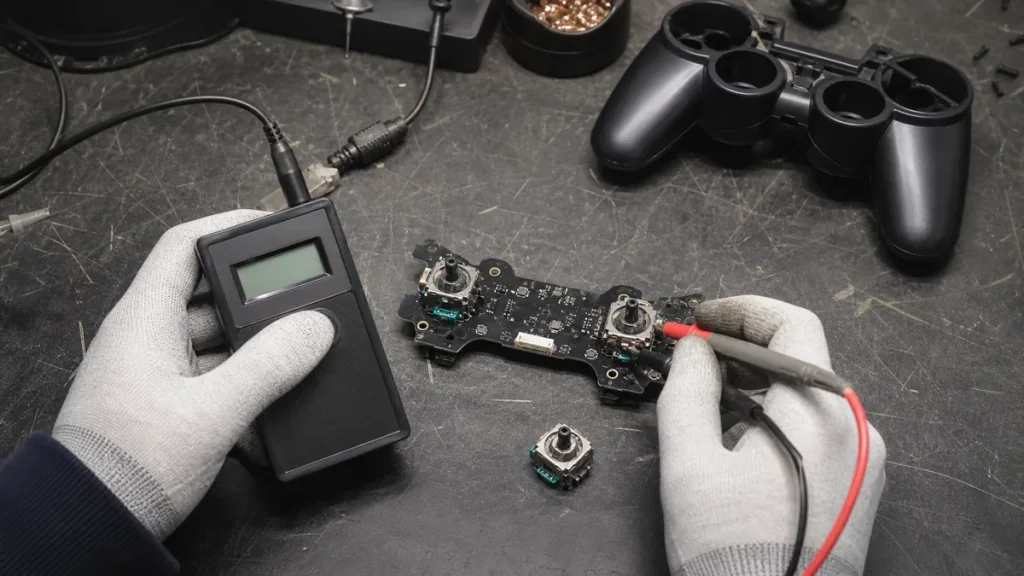
Buyers should confirm module supplier, resolution, center accuracy, dead-zone settings, calibration method and compatibility with the selected PCB.
The technical brief should distinguish a target from an acceptance limit. A target describes the preferred result; the limit determines whether a unit passes. For Hall Effect joystick technology, recording both prevents a supplier from treating every visible difference as acceptable and prevents a buyer from rejecting normal manufacturing variation without an agreed basis.
Calibration Matters More Than the Label
Hall Effect modules may increase component and development costs, while testing and calibration can also affect lead time.
Cost discussion becomes clearer when requests are divided into base requirements and upgrade options. The supplier can then show which change affects tooling, which affects unit cost and which adds testing time. This approach gives the buyer choices instead of one unexplained final price. For Hall Effect joystick technology, each commercial assumption should be recorded beside the technical option so later price comparisons remain meaningful.
On a factory floor, consistency in Hall Effect joystick technology depends on ordinary controls performed at the correct moment. Incoming parts must be identified by lot, fixtures must be checked before use, operators need an unambiguous work instruction and inspectors need a boundary they can apply without guessing. Final inspection remains important, but it cannot economically repair a process that has been allowed to drift through an entire shift. Buyers should therefore ask not only what is tested, but where the test sits in the production route and what happens when a result falls outside the limit.
A Sensible Hall Effect Approval Sequence
An experienced OEM/ODM manufacturer can evaluate suitable joystick modules, develop samples and complete calibration and functional testing for controller projects.
Before approval, place the sample beside the written requirement and review them together. Photograph important details, record measured results and list any accepted deviation. For Hall Effect joystick technology, this final review should produce one clear reference that production, quality and purchasing teams can all recognize.
A practical buyer action is to create a one-page control brief for Hall Effect joystick technology. List the intended user, the three characteristics that must not vary, the evidence required at sample approval and the checks expected during production. Attach photographs only where they clarify a boundary. This document need not replace a full specification; its purpose is to keep commercial and technical priorities visible. Send it with the inquiry and ask the supplier to identify any point that cannot be achieved on the proposed platform before quoting.
Prepare a Clear Brief for Hall Effect Joystick Technology
Start with the target market, required performance, expected order quantity and an agreed sample standard for Hall Effect joystick technology.
For a Hall Effect joystick technology specification review, write to info@rayforandy.com.